


A UL control panel manufactured to UL 508A requirements supports code-aligned construction, reduces electrical risk and gives your team clearer documentation from build through installation.
UL 508A sets the rules for panel construction and labeling, while the National Electrical Code governs how the finished panel is installed and applied. A qualified manufacturer reviews component ratings, protection requirements and panel layout before production begins, helping prevent compliance issues, delays and expensive rework.
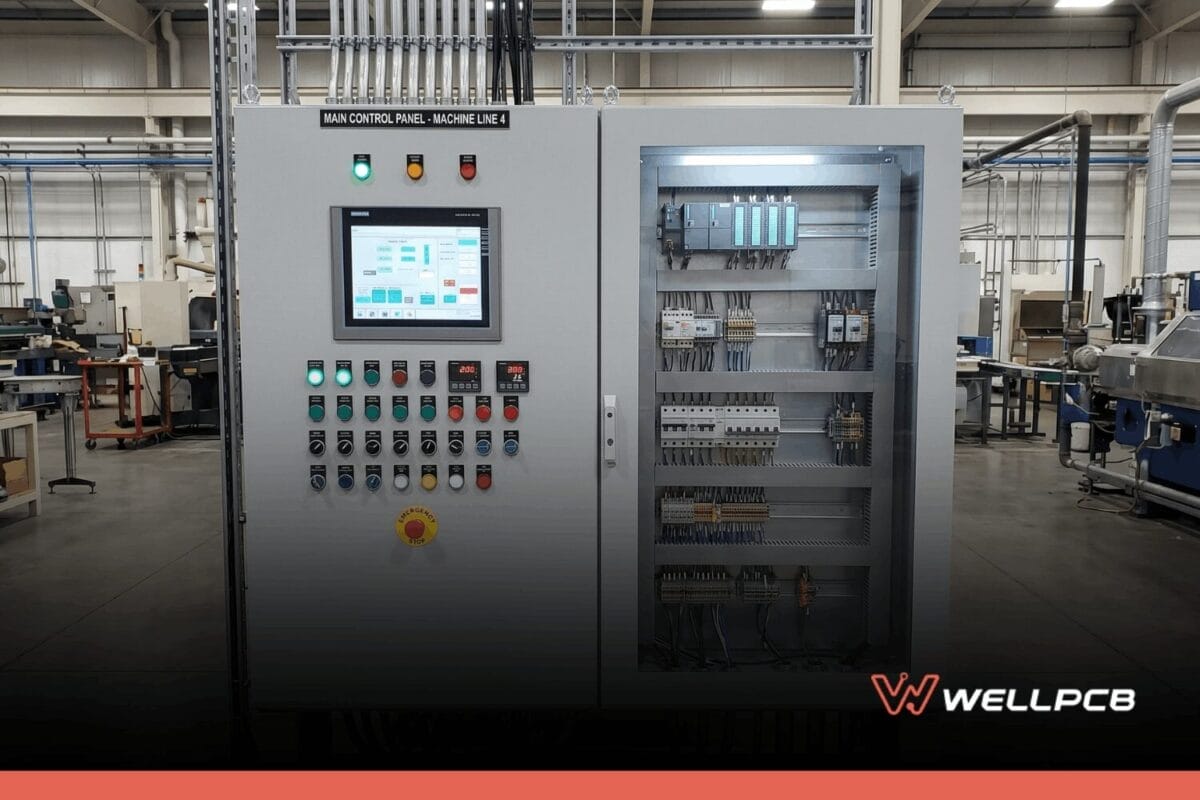
What is a UL 508A Control Panel?
UL 508A defines construction, spacing, and safety requirements for industrial control panels in ordinary locations. The standard covers both enclosed and open-type assemblies rated up to 1000 V AC/DC at 104 °F ambient.
Certification evaluates the complete panel assembly (not individual components) for electrical, mechanical, and fire safety. It verifies nameplate data, SCCR markings, wiring methods, and documented construction to reduce inspection delays and enable safer industrial startup.
What UL 508A Covers vs. Excludes
UL 508A defines where the standard applies and where it stops. This scope matters because a compliant panel for one installation may fail review in another. Clear boundaries help panel builders specify the right product standard before design work starts.
What UL 508A Covers:
- Assemblies with two or more power or control circuit components in ordinary locations.
- Panels rated at 1,000 V AC/DC or less in ambient temperatures up to 104 °F.
- Enclosures with factory-installed components and internal wiring methods.
- Industrial machinery, such as metalworking machines or plastic injection equipment.
- Applications such as cranes, hoists, and elevators in non-hazardous areas.
What UL 508A Excludes:
- Hazardous Class I, II, or III locations.
- Equipment rated above 1,000 V.
- Residential or consumer appliances.
- Switchboards covered by UL 891 and panel boards covered by UL 67.
- Motor control centers covered by UL 845.
- Simple assemblies with one device or basic terminal strips.
- Field-installed equipment or remote equipment.
- Stationary engine-driven control units covered by UL 6200.
- Intrinsically safe barriers for hazardous locations.
Benefits of UL Certified Control Panels
UL certification gives buyers independent proof of compliance. For industrial control panels, third-party review reduces approval friction during inspection and equipment startup. Because a UL 508A-certified panel shop follows recognized safety rules, it speeds up inspections.
Benefits include:
- Enhanced safety through proper component selection, wiring methods, and spacing.
- Faster inspections through visible compliance evidence for the authority having jurisdiction.
- Higher reliability through standardized construction and listed control panel parts.
- Regulatory compliance with NEC Article 409 and CEC expectations.
- Insurance support through documented UL-certified control panels.
- Market access for bids, tenders, and original equipment manufacturer specifications.
- Ongoing quality through recurring audits at the certified panel shop.
Three Circuit Types in UL 508A Panels
UL 508A separates panel wiring by circuit function and energy level. The circuit class affects component selection, conductor rules, and evaluation during panel review. Correct classification keeps the control panel aligned with code and listing expectations.
Power circuits:
- Supplies motors, heaters, and other load-side equipment.
- Includes feeder circuits and branch circuits within the panel.
- Requires UL Listed components and a verified short-circuit current rating.
Control circuits Class 1:
- Operates relays, contactors, programmable logic controllers, and human-machine interfaces.
- Supports command and signaling functions within the control system.
- Permits UL-recognized components where the standard allows them.
Class 2 Circuits:
- Limits available power to less than 100 volt-amperes.
- Allows for more flexible wiring rules and smaller conductors.
- Serves low-energy functions where reduced fault energy changes construction requirements.
UL 508A Assembly and Construction Requirements
UL 508A assembly rules dictate how a control panel must be built to pass code review. The construction review focuses on component approval, conductor sizing, and the physical layout inside the enclosure. Internal sequencing logic sits outside this part of the safety standard.
Requirements include:
- Use UL Listed or UL recognized components permitted under Appendix C.
- Match the enclosure to site conditions through the correct NEMA or Type rating.
- Size conductors from the NEC ampacity rules and Table 28.1 values.
- Apply derating when bundled wiring raises heat inside the panel.
- Follow the 1/10 tap rule for group motor control applications.
- Maintain the required spacing between live parts and grounded metal.
- Provide proper grounding and motor overload protection.
- Mark the terminal torque values where the standard requires them.
How SCCR Is Determined and Marked
Short-circuit current rating (SCCR) defines the maximum fault current that a UL 508A control panel can withstand. Supplement SB of UL 508A provides the step-by-step calculation method for determining SCCR across feeder circuits and branch circuits within the panel. Marking errors often start with unrated terminals or missed transformer impedance values.
Use this process to determine SCCR:
- Assign a rating to each power-circuit component from its marked value, Table SB4.1, or a tested combination.
- Apply current-limiting fuses or breakers when they raise downstream component ratings.
- Use the lowest resulting value across feeder sections and branch sections.
- Mark the exact SCCR and voltage on a permanent nameplate.
- Confirm that the marked value exceeds the available fault current at the installation site.
UL Panel Shop Certification Program
A UL panel shop certification program lets qualified manufacturers apply labels in-house. Approval depends on trained personnel, documented quality control, and regular audit performance. Each labeled panel must trace back to complete compliance records.
Program requirements include:
- Train the Manufacturer Technical Representative before label use begins.
- Establish a documented quality system for panel construction and review.
- Complete the initial UL audit before production labeling starts.
- Pass unannounced follow-up audits that verify ongoing compliance.
- Maintain records for every labeled UL 508A control panel.
Common Applications of UL508A Control Panels
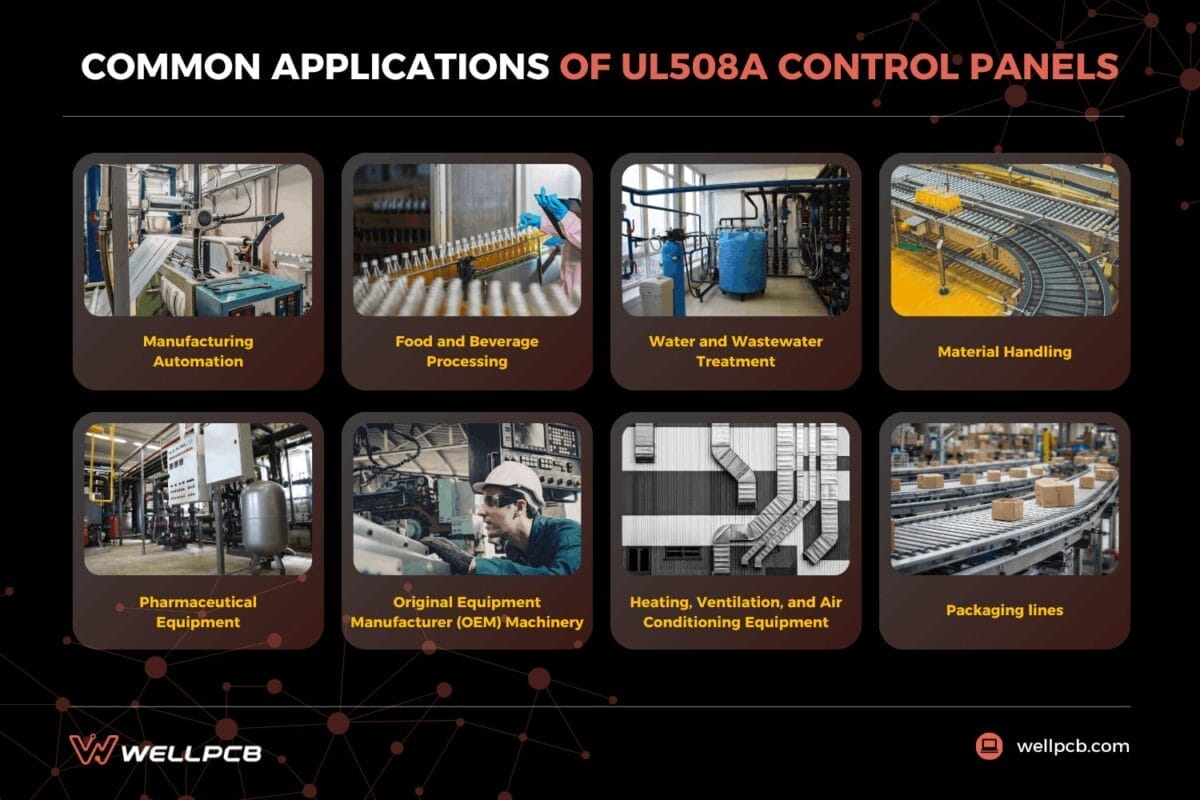
UL 508A control panels support a wide range of industrial applications. Application scope matters because circuit demands and environmental exposure change construction requirements. Panel builders match each assembly to the machine, load profile, and operating conditions. Common applications include:
Manufacturing automation
Includes computer numerical control machining centers, robotic welding cells, automated inspection stations, stamping presses, and production lines with variable frequency drive motor control.
Food and beverage processing
Includes mixers, pasteurizers, high-speed filling lines, clean-in-place skids, and fryer control systems.
Water and wastewater treatment
Includes pump control panels, lift stations, chemical dosing skids, filtration systems, and supervisory control and data acquisition interface panels.
Material handling
Includes conveyor systems, overhead cranes, automated storage systems, sorters, palletizers, and automated guided vehicle charging stations.
Pharmaceutical equipment
Includes cleanroom environmental controls, tablet presses, sterile filling lines, lyophilizers, and bioreactor panels.
Original equipment manufacturer (OEM) machinery
Includes custom injection molders, printing presses, woodworking equipment, textile machines, and specialty production tools.
Heating, ventilation, and air conditioning equipment
Includes air-handling units, chiller plants, boiler controls, rooftop units, and cooling tower panels.
Packaging lines
Includes form-fill-seal machines, cartoners, labelers, case packers, and end-of-line automation systems.
Choosing a Reliable UL 508A Panel Builder
A reliable UL 508A panel builder controls risk before fabrication starts. Shop capability matters because weak documentation or poor testing can delay startup and create field failures. Use a simple checklist to screen panel manufacturers before you release the job.
Checklist:
- Verify current UL 508A certification and authorized label use.
- Confirm documented testing methods for finished assemblies.
- Review quality control procedures for wiring and torque verification.
- Request complete build records and compliance documentation.
Finding a partner who excels in these areas is key to your project’s success.
WellPCB operates its own PCB and assembly factories, giving engineering teams and procurement managers a single point of accountability rather than a chain of separate vendors. Backed by ISO 9001 and IPC 610 Class 3 certification, every panel, wire harness, and cable assembly is tested against the approved design and applicable standards before it leaves the factory.
Contact WellPCB to build your custom, certified control panel assembly with manufacturing support that moves your approved design into reliable field performance.
UL Control Panel FAQs
What is the difference between UL 508A and NFPA 79?
UL 508A covers the construction and assembly of an industrial control panel. NFPA 79 covers the electrical safety of the entire machine, including the panel, field wiring, and connected equipment. A machine can use a UL 508A control panel, yet still need separate review under NFPA 79.
Can a UL 508A panel be modified in the field?
A UL 508A panel can accept minor field changes when the work still follows UL 508A construction rules. Larger modifications can affect spacing, component suitability, or short-circuit current rating, which can void the certified label. Field changes that alter compliance often require review by the panel shop or re-evaluation by the authority having jurisdiction.
Is UL 508A certification legally mandatory?
UL 508A certification is not always a direct legal requirement. However, site inspectors, insurers, and end customers commonly require it before approving installation, coverage, or project acceptance. In practice, certification often becomes a business requirement even when the law does not explicitly require it.
Back to Top: UL Control Panel | UL 508A Industrial Control Panel Manufacturing


