


Panelboards and switchboards sit at different levels of a building’s power distribution hierarchy, and specifying the wrong one creates problems that surface long after installation. Under-rated gear voids equipment breakdown insurance. A panelboard rated for 10 kAIC installed where the utility can deliver 65 kAIC of fault current cannot interrupt that fault safely – the gear fails violently rather than tripping cleanly. Selective coordination errors let a shorted branch circuit pull down a panel that should have isolated the fault locally.
Engineers and facility owners specifying distribution equipment are typically deciding between three classes: panelboards, switchboards, and switchgear. The right choice depends on load size, available fault current, voltage class, and how critical operational continuity is during maintenance.
This guide compares the three across the dimensions that actually drive specification: ratings, construction, accessibility, applicable standards, and the selection factors that decide which assembly fits a given project.
Panelboard Overview
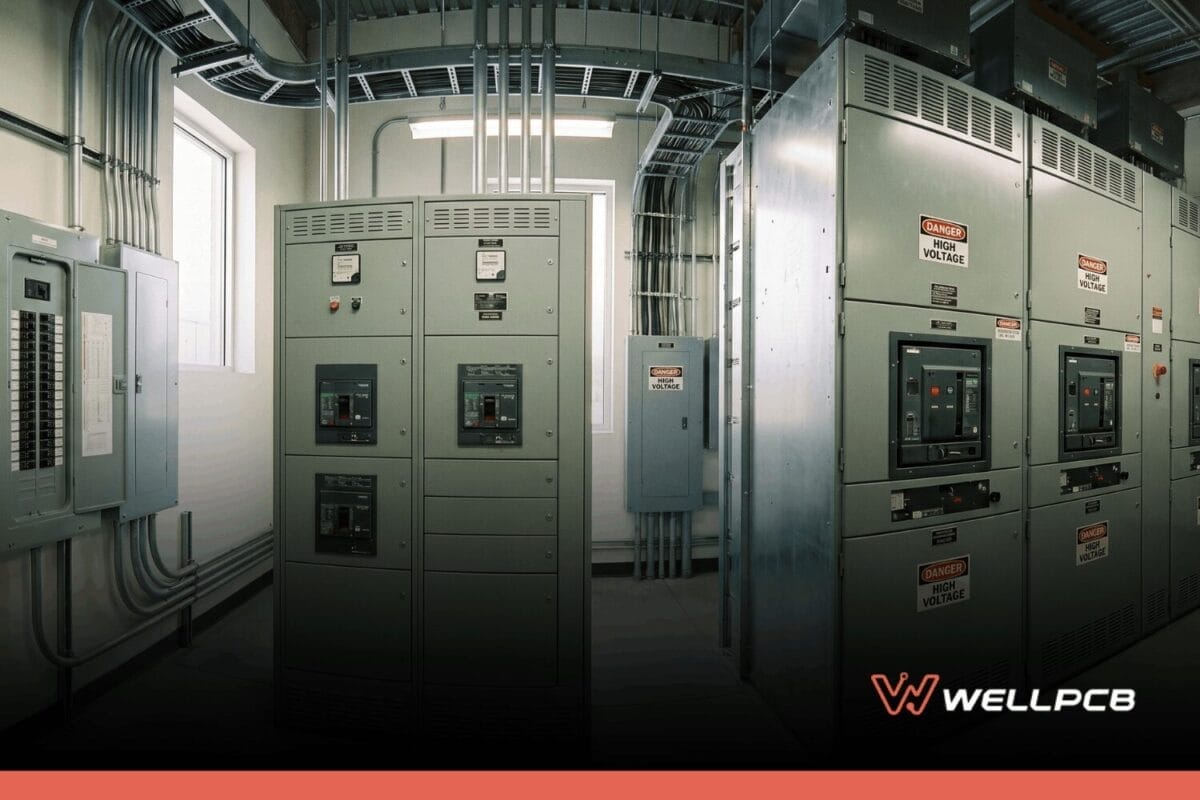
A panelboard is a space-efficient electrical distribution unit that handles branch-circuit protection and final load delivery inside commercial and industrial facilities. The assembly houses molded-case circuit breakers or fuse devices that feed localized loads like lighting or small HVAC equipment.
Each molded case circuit breaker trips on overcurrent to isolate a faulted branch circuit’s path before damage spreads. A power panel is a practical option for lower electrical demands when dedicated rooms aren’t available. The power panel sits close to its served loads, shortening the feeder runs across the layout.
Switchboard Overview
A switchboard is a freestanding distribution hub that receives electrical power from the utility and delivers it to downstream panelboards or heavy machinery. The assembly features a main disconnect with integrated metering on a heavy-duty bus, supporting high-load environments across full-facility sections.
A switchboard lineup acts as the intermediate stage between service entry equipment and final building distribution gear. The lineup handles aggregated facility loads, splitting electrical power into separately protected feeders that route to machinery or downstream panelboards.
Differences Between Panelboard and Switchboard
Panelboards and switchboards differ across engineering and practical dimensions that shape equipment selection and long-term power distribution system design. Each dimension below carries real consequences for how a facility operates over time.
Mounting style and physical construction
A panelboard installs flush or surface-mounted inside a wall cavity, with an enclosure depth shallow enough to fit within finished interior walls. Retrofit projects favor the format because the slim profile fits existing wall construction without structural modification, which is also why panelboards remain the default choice for branch distribution in commercial fit-outs even when load growth is expected.
A switchboard uses a multi-section vertical chassis with separate compartment bays for protective gear and automatic transfer switches. Bus bracing runs the full depth of the chassis, distributing mechanical stress across the entire structure during a short-circuit event. The bracing matters most when fault current is high: a switchboard rated to 65 kAIC stays mechanically stable through a fault that would deform or shear the bus structure inside a wall-mounted panelboard.
Accessibility and maintenance considerations
A panelboard is accessible only from the front, which suits tight-wall installations but boxes in technicians during fault tracing or breaker swaps. Single-sided entry forces every cable termination and fault check onto one face of the enclosure during any service visit. It’s manageable for a 200 A lighting panel, but increasingly limiting as ampacity climbs.
A switchboard provides front- and rear-access along the full lineup, clearing direct paths for cable inspection and breaker replacement. Rear-side openings also pull heat from the cabinet during sustained high-current operation, which matters most as electrical loads approach rated capacity. For service-entrance equipment that runs continuously near the nameplate, rear access is the difference between a planned maintenance window and a thermal-event-driven shutdown.
Voltage ratings and current capacity
Panelboards and switchboards share a low-voltage ceiling of 600 V. Panelboards typically carry 100 A to 1,200 A with interrupting ratings ranging from 10 kAIC to 65 kAIC on standard builds — adequate for branch distribution and final load delivery in commercial and light industrial settings.
Switchboards handle 800 A to 5,000 A with stronger fault interruption between 25 kAIC and 100 kAIC inside the assembly. The higher fault-current withstand is what makes switchboards the correct fit for main-breaker service-entrance duty in larger commercial buildings — and why specifying a panelboard at the service entrance of a facility with high available fault current is one of the more dangerous mis-specifications in low-voltage distribution design.
Standards compliance and safety features
UL 67 governs panelboard construction, including dead-front design rules and tested overcurrent protective device requirements. It sits within the broader NEC Article 408 framework and applies to both equipment classes at the installation level.
UL 891 raises the bar for switchboard design with stricter bus-bracing requirements and short-circuit withstand testing protocols. Most switchboard builds include insulated bus with ground-fault protection that exceeds baseline requirements. The practical implication for specification is that a UL 67 panelboard cannot substitute for a UL 891 switchboard at the service entrance, even when the ampacity numbers appear similar on paper – the construction and bracing differences make the switchboard safe at the fault levels the service entrance actually sees.
Switchgear vs. Switchboard vs. Panelboard
Each assembly occupies a different position in the power distribution hierarchy based on voltage range, fault current capacity, and the protection level the application requires. A panelboard handles final load protection at the branch level.
A switchboard manages higher incoming currents at the service entrance or intermediate distribution point. Switchgear handles voltages and fault currents that exceed what either assembly can safely withstand, and is the only one of the three built for live maintenance on critical systems.
Switchgear overview
A switchgear is a metal-enclosed assembly of circuit breakers and disconnect switches that controls and isolates electrical equipment for an electrical system. The assembly detects faults and isolates affected sections of the distribution path without pulling the rest of the connected installation offline.
Draw-out breakers and integrated relays monitor power parameters across each compartment, triggering protective devices the moment an anomaly appears in the system. At the top end, the assembly spans medium- and high-voltage applications from 1 kV up to 38 kV, meeting ANSI C37 and NEMA SG-5 requirements for metal-enclosed construction.
Low-voltage switchgear up to 600 V is covered by UL 1558, with an interrupting capacity of 200 kAIC or higher in those assemblies.
Quick reference: panelboard vs. switchboard vs. switchgear
| Feature | Panelboard | Switchboard | LV Switchgear | MV/HV Switchgear |
|---|---|---|---|---|
| Voltage Rating | Up to 600 V | Up to 600 V (some to 1,000 V) | Up to 600 V | 4.16–38 kV |
| Current Capacity | 100–1,200 A | 800–5,000 A | 1,200–6,000 A+ | Varies by kV rating |
| Mounting Style | Wall-mounted | Freestanding | Large, freestanding, compartmentalized | Large, freestanding, compartmentalized |
| Access | Front only | Front and rear | Front and rear with draw-out | Front and rear with draw-out |
| Interrupting Rating | 10–65 kAIC | 25–100 kAIC | 100–200 kAIC+ | Rated in kA symmetrical at the given kV |
| Standards | UL 67, NEMA PB-1 | UL 891, NEMA PB-2 | UL 1558, ANSI C37, NEMA SG-5 | ANSI C37, NEMA SG-5 |
| Typical Applications | Branch distribution, lighting, small HVAC | Service entrance, intermediate distribution in commercial buildings | Critical systems, data centers, healthcare, large industrial | Substations, power plants, heavy industrial, utility |
Selection Factors and Best Practices

Getting equipment selection wrong creates code violations and safety exposure that surface late in a project when fixes are most expensive. A qualified electrical engineer running coordination studies and arc-flash analysis keeps every decision grounded in verified system data.
- System load and ampacity: Match the assembly to the load. Panelboards suit lighter branch distribution. Switchboards handle service-entrance and intermediate distribution. High-density applications past standard switchboard ratings call for switchgear.
- Available fault current: A qualified engineer needs to run a fault study before any equipment is specified. Gear unable to interrupt the available fault energy creates fire and arc-flash exposure that surfaces only during the fault itself – too late to fix.
- Operational continuity: Hospitals, data centers, and continuous manufacturing facilities need assemblies that keep the broader electrical system live while individual sections come offline for maintenance. Switchgear is the only assembly class built for live maintenance on a running system.
- Future expansion: Switchboards typically offer the most flexible mid-range capacity for facilities expecting moderate load growth. This is easier to add feeders without re-specifying the entire service-entrance assembly.
- Enclosure rating: Match the enclosure’s NEMA or IP rating to the actual environment. NEMA 4X for corrosive coastal and washdown environments. NEMA 12 for dusty, non-corrosive areas. NEMA 3R for outdoor installations.
- Monitoring and metering: Smart panels with Modbus or SNMP metering deliver real-time energy data and predictive maintenance signals. This is useful for facilities running close to demand peaks or trying to attribute consumption to specific loads.
- Coordination study: Selective coordination keeps localized faults from cascading upstream. Required for many healthcare and emergency-power applications under NEC, and worth doing for any facility where loss of a main breaker means significant downtime.
From Specification to Manufactured Reality
The selection decision is one half of a distribution project. The other half is the assembly itself: the bus structure, the control wiring inside the gear, the PCB-based metering and monitoring modules, and the cable harnesses that connect protective relays to disconnect switches. Spec-driven choices only hold their value when the assembly behind them is built to the same standard the design called for.
That’s where WellPCB fits into power distribution projects. The team builds the PCB assemblies, metering hardware, control wiring, and integrated electronics that sit inside industrial control panels and distribution gear. Production operates under ISO 9001, ISO 14001, IPC 610 Class 3, and UL certification, with components sourced exclusively through authorized distributors including Arrow, Avnet, Digi-Key, and more.
For panel builders, OEMs, and integrators specifying the electronics inside panelboard, switchboard, and switchgear assemblies, the gap between a spec sheet and a reliable build comes down to who sourced the components and who tested the workmanship.
Request a quote for PCB assembly or integrated electronics manufacturing used in panelboard, switchboard, and power distribution system applications.
Panelboard vs. Switchboard FAQs
Can a switchboard be used in place of a panelboard?
Yes, but it’s not practical. Switchboards can supply branch circuits, but the added cost and physical footprint make them the wrong fit for loads that a panelboard handles comfortably.
When is switchgear required over a switchboard?
Switchgear is required when the voltage exceeds 600 V or the available fault current exceeds the switchboard’s interrupting capacity. Compartmentalized protection and draw-out breaker maintenance in critical infrastructure also point to switchgear.
What’s the difference between a panelboard and a load center?
Both fall under UL 67 but sit at different grades. Load centers are residential equipment with lower interrupting ratings (typically 10 kAIC) and plug-in breakers. Commercial panelboards use higher interrupting ratings, more robust bus construction, and bolt-on breakers. Specifying a load center for a commercial branch panel is a common mixed-use building mistake; the cost difference disappears against the first inspection failure.
What changes can be specified during the panelboard or switchboard order?
Common buyer-specified changes: bus material (copper or aluminum), interrupting rating, metering packages (Modbus, SNMP, branch-circuit monitoring), surge protection, ground-fault thresholds, and enclosure rating (NEMA 1, 3R, 4X, 12). Long-lead changes, such as specific breaker brands, pre-installed transfer switches, should be flagged at the quote stage, not after the build queues.
Back to Top: Panelboard vs. Switchboard: Comparison for Power Distribution Systems


