


Electrical control panel wiring standards protect personnel and keep panels legally compliant across industrial and commercial environments. Three standards govern how industrial control panels are wired, built, and installed in North America: UL 508A for panel construction, NEC Article 409 for facility installation, and NFPA 79 for panels integrated into industrial machinery.
Each standard covers a distinct compliance layer, and a panel that satisfies one but not the others will still fail inspection, which is why panel builders and OEMs need to treat the three as a single integrated framework rather than separate checklists.
This guide walks through what each standard actually requires for control panel wiring: conductor sizing, spacing, grounding, short-circuit current rating, and labeling – then covers the execution gaps that most commonly cause inspection failures and the post-installation factors that void a listing even on a perfectly built panel.
The Three Main Standards
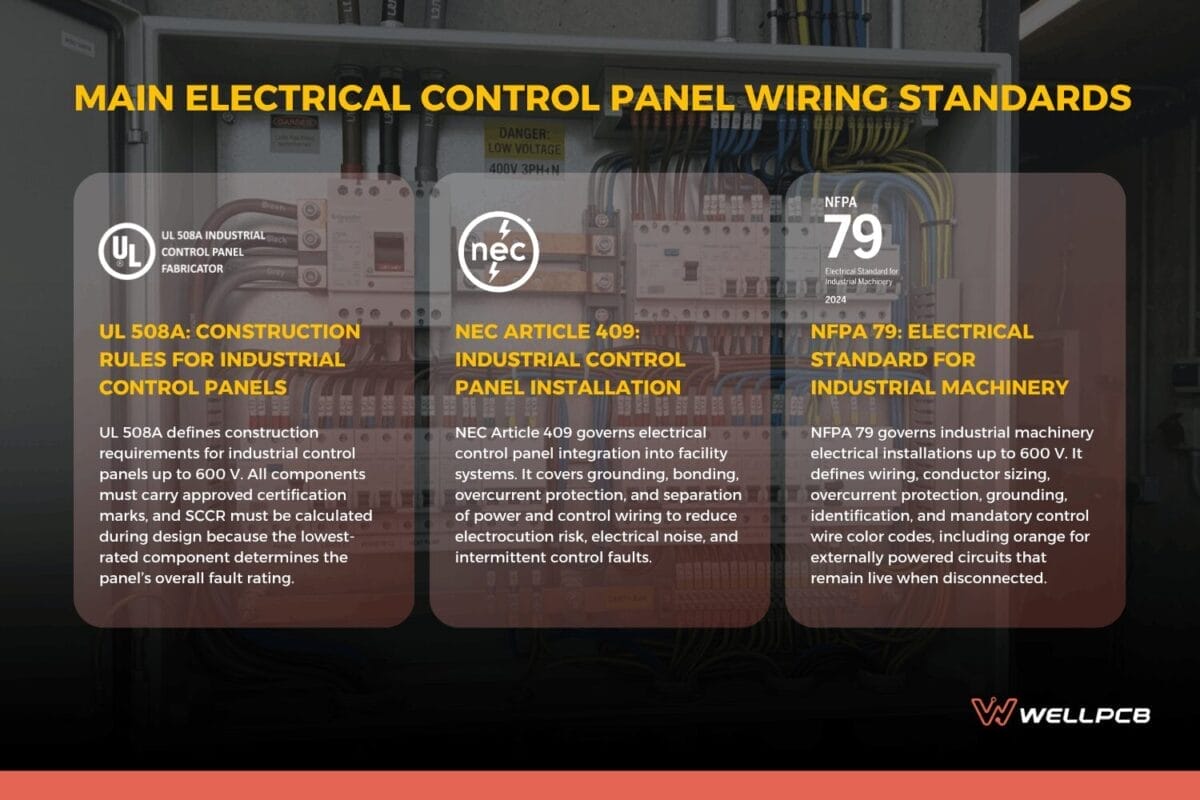
Electrical control panel wiring standards draw from three distinct frameworks. Reliable panel approval depends on meeting all three standards simultaneously.
UL 508A: Construction Rules for Industrial Control Panels
UL 508A governs how factory-built industrial control panels rated 600 V or less are constructed. Every component installed inside the panel must carry documented certification marks before it goes in – an unmarked device fails inspection regardless of how well it performs in service, and substituting one during repair is one of the fastest ways to void a listing on an otherwise compliant panel.
The standard also requires the panel’s short-circuit current rating to be calculated and marked on the finished build. Establishing SCCR has to happen during design, not after, because the SCCR is determined by the lowest-rated component in the fault current path. This means that a single under-rated terminal block can cap the entire panel’s rating and force a re-spec mid-project if it isn’t caught early.
Wiring and spacing requirements set by UL 508A include:
- Conductor sizing per Table 28.1, based on 75°C insulation rating
- 0.5 inches minimum between live parts at different potentials
- 1 inch minimum between panel components and enclosure walls
- 0.5 inches minimum separation between wire bundles for airflow and heat dissipation
- Short-circuit current rating documented and marked on every finished panel
The spacing requirements look small on paper but matter most in tightly packed enclosures, where a routing decision made during the build can be the difference between a passing inspection and a red tag.
NEC Article 409: Industrial Control Panel Installation
NEC Article 409 governs how an electrical control panel ties into the facility electrical system once it leaves the shop. Grounding and bonding requirements reduce electrocution hazard during faults, overcurrent protection has to cover every circuit downstream of the main disconnect, and power and control circuit paths need to be physically separated inside the enclosure – a requirement that exists because mixing power and control wiring in the same bundle is one of the most common causes of induced noise and intermittent control faults in service.
Conductor identification and panel marking requirements under NEC Article 409 include:
- Conductor ampacity sized per applicable NEC tables
- Clear labeling at both ends, matching the wiring diagram exactly
- Short-circuit current rating displayed on the finished panel
- Approved wiring methods throughout the installation
The labeling requirement is straightforward at build time and almost always the first thing to drift out of compliance during the panel’s service life. Field modifications that update the wiring without updating the schematic are the most cited reason compliant panels fail follow-up audits.
NFPA 79: Electrical Standard for Industrial Machinery
NFPA 79 applies to electrical installations on industrial machinery rated 600 V or less. Where machinery-specific safety requirements are involved – emergency stops, safety interlocks, control circuit protection – NFPA 79 overrides UL and NEC guidance on those points, because the standard exists specifically to protect operators interacting with the machine, not just the panel feeding it.
NFPA 79 wiring and conductor requirements include:
- Conductor sizing per Table 10.1 for 30°C ambient
- Motor branch circuits sized at 125% of motor full load amperes
- Overcurrent protection for branch circuits at 150% of full load current
- Equipment grounding conductor sizing per Table 10.3
- Every conductor identified at both ends
The standard also specifies color codes for control wiring identification:
- Green/yellow or bare: equipment grounding
- White/gray: neutral
- Red: AC control circuits
- Blue: DC control circuits
- Orange: externally powered circuits that stay live when the panel is powered off
- Yellow: interlock wiring
The orange convention is the one that catches out service technicians most often: a circuit that stays live when the main disconnect is open is exactly the failure mode color coding is designed to prevent, which is why NFPA 79 treats it as a required identification convention rather than a recommendation.
How the Standards Work Together

The three standards run in sequence across a panel’s lifecycle. UL 508A governs how it’s built and which components qualify for installation. NEC Article 409 governs how it connects to the facility once installed. NFPA 79 layers stricter safety requirements on top whenever the panel forms part of industrial machinery rather than just feeding it.
Treating any single standard in isolation creates a compliance gap that will be caught somewhere. A panel built only to UL 508A risks failing NFPA 79 machinery inspection on safety circuit requirements. A panel built to NFPA 79 but installed without NEC Article 409 grounding fails a site audit.
The cost of fixing these gaps depends entirely on when they’re caught: a missed spec at the design stage costs revisions, the same gap caught at site audit costs a return trip plus re-inspection fees, and the same gap caught after a fault costs incident reporting and potential liability. Modern control panel builds need all three connected standards addressed together at the design stage – not sequenced as separate compliance checkpoints.
Where Compliance Most Often Fails in Practice
Most panel listing failures don’t come from misreading the standards; they come from execution gaps that surface after the original build is approved. Inspectors routinely red-tag panels that were fully compliant when they left the shop, with later changes introducing violations that wouldn’t have been allowed in the original design review. Five patterns account for most of those failures.
Component selection and certification
A panel leaves the panel shop fully certified, then a technician swaps a contactor from an unmarked spare bin during a repair. One substitution from an unmarked bin voids the listing on an otherwise compliant industrial control panel. Panel shop records must cover every replacement device, not just the original panel assembly components.
Spacing and clearances
The most common spacing violation that inspectors red-tag isn’t the original build. Added VFDs shoved into leftover enclosure space after installation are the primary cause of re-inspection failures on otherwise compliant panels. Retrofitted electrical components rarely receive the wall clearance or wire-bundle separation provided by the original layout.
Power and control wiring separation
The 6-inch separation rule is most often bypassed in retrofits and tight motor control centers, where routing space is limited. Installers under time pressure bundle power and control wiring together, introducing electrical noise that corrupts control system signal integrity. New loads added without a layout review invalidate wiring methods that previously met best practices.
Identification and labeling
Unrecorded field modifications are the leading cause of labeling failures across industrial control panel inspections. A technician re-routes a conductor and updates the physical connection, but skips revising the electrical schematics to match the change. Mismatched prints turn a compliant control panel into a follow-up audit failure.
Grounding and overcurrent protection
Upsizing a circuit breaker without resizing the wire removes the coordination that the original design provided against fault current. The most cited overcurrent mismatch pairs an upsized breaker with the original undersized conductor. Grounding failures follow the same pattern when retrofit bonding jumpers get omitted or undersized for the updated electrical system load.
Compliance Considerations
Electrical control panel compliance extends well beyond the shop floor build. Site conditions and post-installation changes each affect whether a panel holds its listing through final audit:
- Environmental ratings: The enclosure NEMA or IP rating has to match the actual site environment before the panel ships. A NEMA 12 panel installed in a NEMA 4X washdown environment fails audit on day one, regardless of how well the internal wiring meets UL 508A.
- Operational safety clearances: NEC 110.26 requires a minimum 3-foot working depth in front of live-front panels rated 600 V or less, with width matching the panel or 30 inches, whichever is greater. Site layouts that block that clearance fail audit even when the panel itself is fully compliant.
- Thermal management: Internal cabinet temperatures over 104°F push most components past their rated operating range. Power supplies, drives, and PLCs exposed to sustained heat above that threshold need active cooling – fans, vortex coolers, or air conditioners – before the panel goes live, not after the first thermal failure.
- Lockout/tagout integration: Applicable LOTO standards require the main disconnect to be lockable in the off position. Designs that retrofit LOTO access after the fact produce repeat findings at site and maintenance audits – it’s a design-stage decision, not a field fix.
- Field evaluation readiness: Panels without a factory UL label require third-party NRTL field evaluation before power-up. Skipping that evaluation gives the authority having jurisdiction grounds to reject the entire installation, with all the rework cost that implies.
- Retrofit and repair logs: Every component swapped after the original build needs its SCCR data logged against the panel record. A single undocumented swap breaks the traceability chain the original UL 508A listing depends on, which is why panel-level documentation needs to live with the panel, not in a shop file that’s never updated.
Building Panels That Hold Their Standard
Compliance with UL 508A, NEC Article 409, and NFPA 79 starts at component selection and ends at the service log entry filed years later. The shops that consistently produce panels passing both initial inspection and follow-up audits are the ones that treat sourcing, documentation, and post-build records as part of the same workflow rather than separate handoffs.
That’s the difference WellPCB builds into industrial control panel assemblies and custom cabinet integration. Authorized-distributor sourcing means the SCCR basis is traceable to documented channels years after the build. IPC 610 Class 3 workmanship and UL-certified processes give inspectors a known reference point. Full DRC before fabrication catches clearance and spacing issues while they’re still cheap to fix. And the documentation package travels with the panel, not the project folder.
Panel builders, OEMs, and compliance teams working on new builds, retrofits, or audit remediation can start a project conversation with schematics, BOM, and target standards – the response comes back with a capability match against your specific compliance basis.
Electrical Control Panel Wiring Standards FAQs
Does NFPA 79 always override other standards?
NFPA 79 generally takes precedence on machinery-specific safety decisions, but a compliant panel typically still needs to satisfy UL 508A and NEC Article 409 where their scopes apply. All three standards are designed to work together rather than in a strict hierarchy.
What if non-UL components are used in a listed panel?
A UL 508A listing covers the panel as a complete system. Non-recognized components can jeopardize that listing unless each exception is documented and shown to meet the original SCCR basis.
Are the NFPA 79 color codes mandatory?
NFPA 79 color codes function as required identification conventions rather than optional styling choices. Consistent application supports inspector approval and gives field technicians a dependable reference during service.
What is SCCR and why does it matter?
Short-Circuit Current Rating is the maximum fault current a panel can safely interrupt. UL 508A requires SCCR to be calculated, documented, and marked on every finished panel, and it’s set by the lowest-rated component in the fault current path. A single under-rated terminal block or contactor caps the rating of the entire panel, which is why SCCR has to be established at the design stage and not after the panel is built.
What’s the difference between a UL listing and a UL recognized component?
A UL listing applies to a complete product or panel as a system – the full assembly carries the listing. UL recognized component (UR) is component-level certification: the part is approved for use inside a listed assembly but cannot be installed standalone. Both marks are accepted under UL 508A, but only when the component is used in line with the conditions of its recognition. Installing a UR-marked component outside its specified conditions voids the listing on the panel it’s installed in.
Back to Top: Electrical Control Panel Wiring Standards


