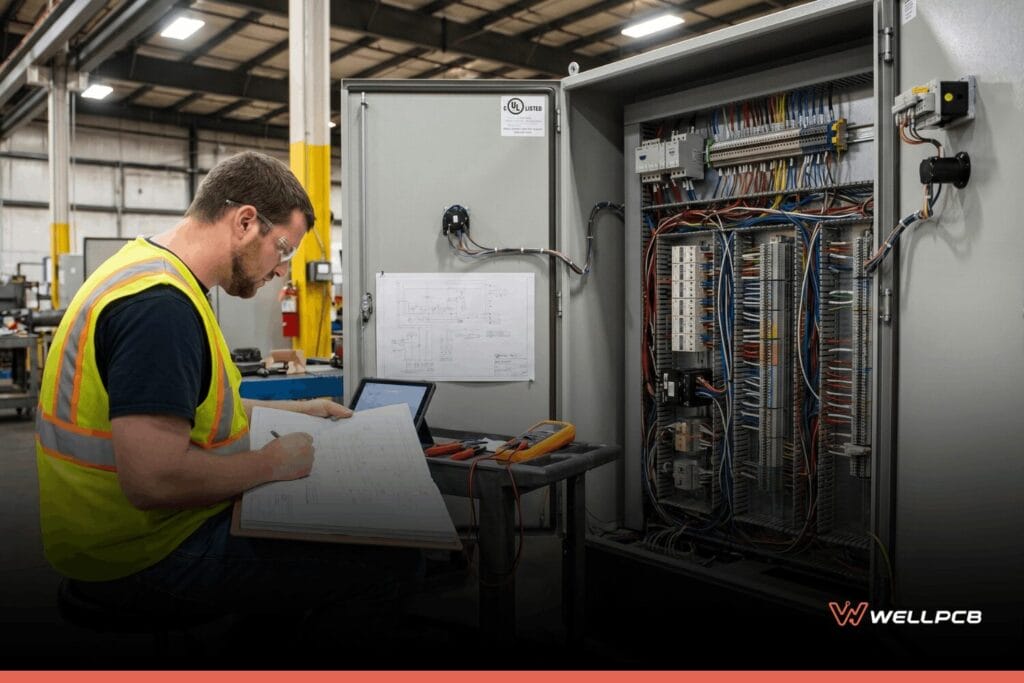
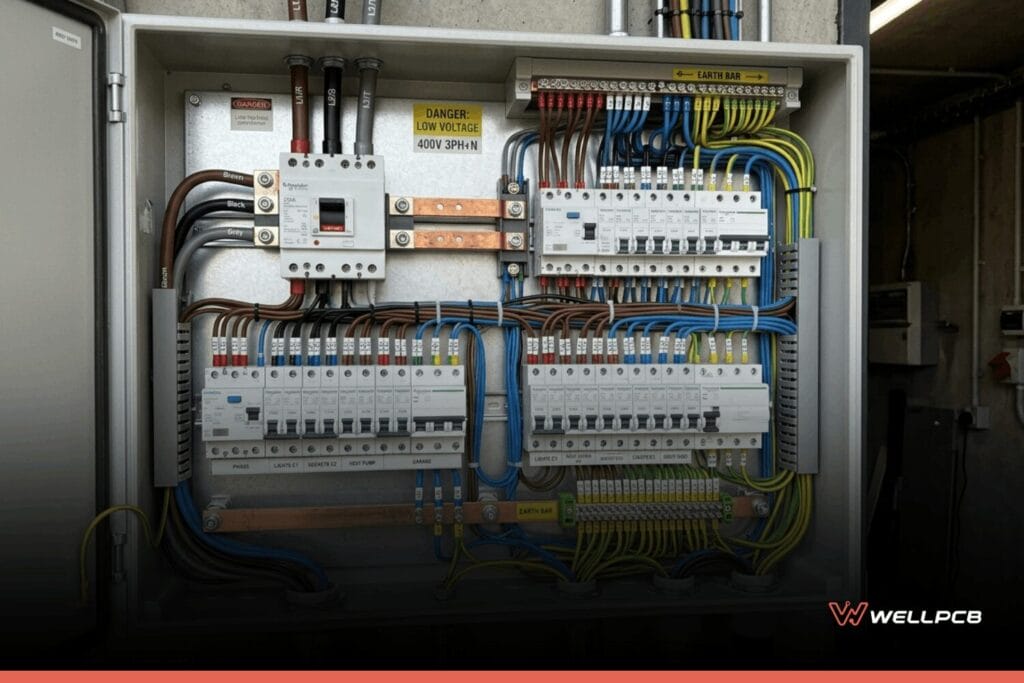
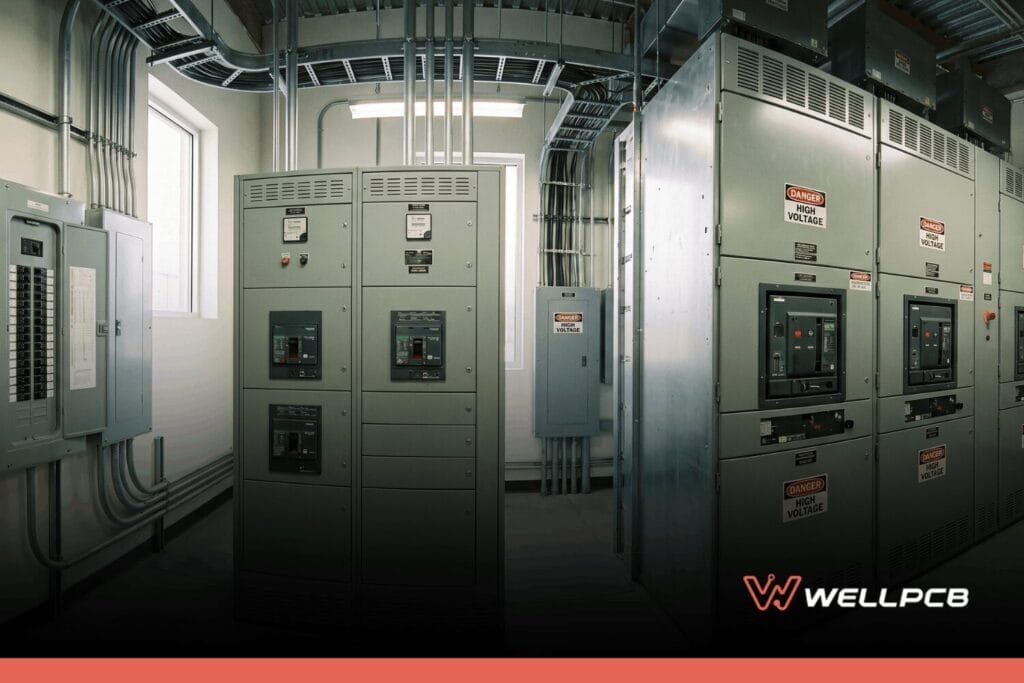
UL 508 and UL 508A are often confused, but they cover different things at different levels. UL 508 is the device-level safety standard for individual industrial control components, such as motor controllers, overload relays, contactors, and similar devices evaluated in isolation. UL 508A is the assembly-level standard for the complete industrial control panel, regarding how those components are wired, spaced, and combined inside an enclosure, including the panel’s overall short-circuit current rating (SCCR).
The distinction matters in practice because a panel built from UL 508 components is not automatically UL 508A compliant, and specifying components without thinking about how they perform together is one of the most common causes of failed panel inspections.
This guide covers what each standard actually evaluates, the key differences between them, related terminology (UL Listed, UL Recognized, “UL Rated”), and the design and procurement decisions that determine whether a finished panel will satisfy UL 508A at inspection.
Contents
- 1 UL 508: Standard for Individual Control Components
- 2 UL 508A: Standard for Assembled Industrial Control Panels
- 3 The Main Differences Between UL 508 vs. UL 508A
- 4 Understanding UL Listed, UL Recognized, and “UL Rated”
- 5 Practical Implications for Design and Procurement
- 6 Supporting Panels That Hold Their Listing
- 7 UL 508 vs UL 508A FAQs
UL 508: Standard for Individual Control Components
UL 508 is the safety standard for individual industrial control components, covering discrete control devices from motor controllers to overload relays.
Manufacturers submit product samples to a laboratory, where assessors measure insulation quality and voltage behavior against defined thresholds. Temperature ratings and mechanical hazard criteria form part of the same evaluation. A component that passes earns the UL mark and qualifies for broader assemblies.
Certification under UL 508 evaluates each device in isolation from the broader industrial control system. Relay and contactor categories each follow the same standalone evaluation process.
UL 508A: Standard for Assembled Industrial Control Panels
UL 508A applies to industrial control panels as complete, integrated systems. The standard examines wiring methods, spacing requirements, grounding, and the overall short-circuit current rating across the full assembly, capturing how components perform together rather than how they perform in isolation. It aligns with NEC Article 409 and is the basis on which inspectors evaluate panels installed in regulated environments.
The reason the standard exists at the assembly level is that fault current behavior and cumulative thermal load both depend on how components are combined inside an enclosure. Neither is predictable from individual device ratings alone. A panel built from fully UL 508-recognized components can still fail UL 508A if the wiring spacing is wrong, the enclosure can’t dissipate the cumulative heat, or the SCCR of the weakest component caps the entire assembly below the available fault current at the installation point.
The Main Differences Between UL 508 vs. UL 508A
UL 508 and UL 508A operate at different levels of the same safety framework. Industrial control projects need to satisfy both: components certified at the device level under UL 508 (or a related standard), then assembled into a panel that satisfies UL 508A at the system level. Treating either standard in isolation creates compliance gaps that surface at inspection.
| Factor | UL 508 | UL 508A |
|---|---|---|
| Scope | Individual industrial control devices | Complete industrial control panels |
| Evaluation | Each device tested in isolation | The assembled panel is evaluated as a whole |
| SCCR | No panel-level SCCR | Single marked SCCR required for the full panel |
| Thermal Focus | Temperature rise of the individual device | Combined heat from all devices in the enclosure |
| Factory Oversight | Follow-up services on listed and recognized devices | Periodic UL inspections of UL 508A panel shops |
Understanding UL Listed, UL Recognized, and “UL Rated”
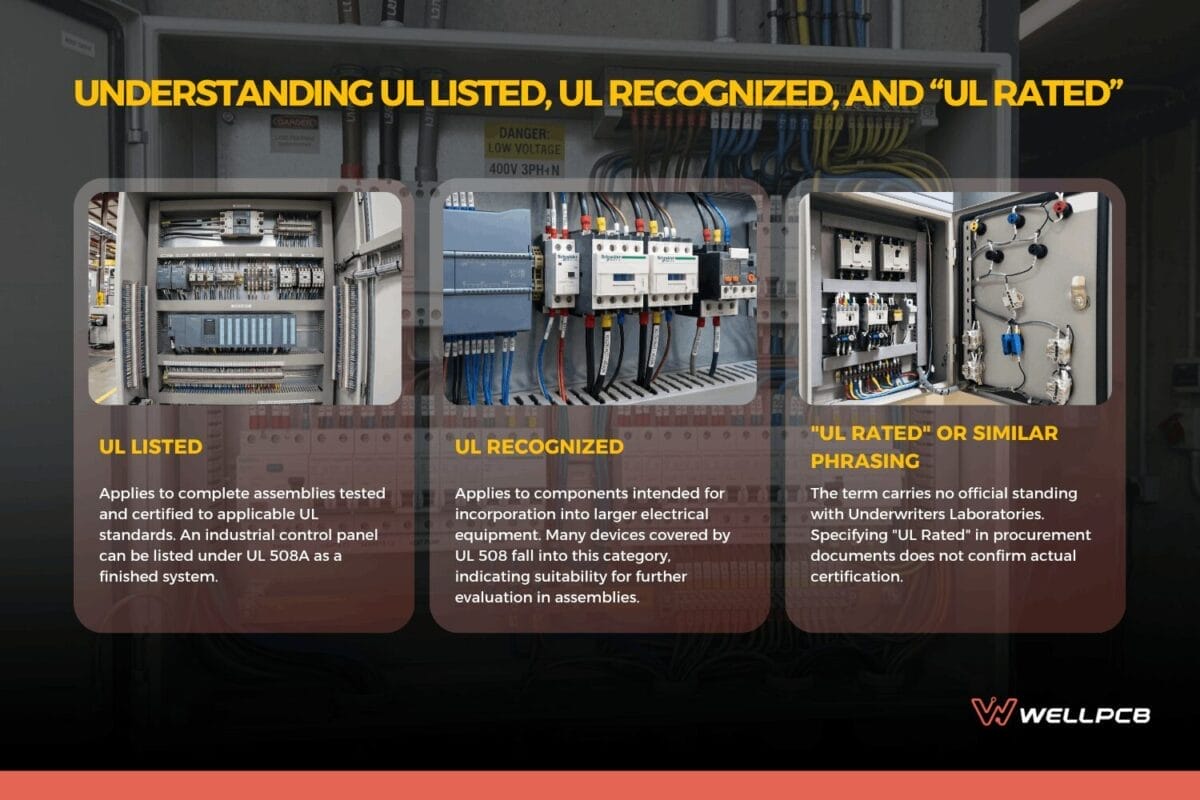
Terminology gaps create real compliance risk. Confusing these designations leads to failed inspections and incorrect specifications. Engineers and procurement teams working with UL 508 and UL 508A requirements need precise language when specifying components and finished panels.
- UL Listed: Applies to complete assemblies tested and certified to applicable UL standards. An industrial control panel can be listed under UL 508A as a finished system.
- UL Recognized: Applies to components intended for incorporation into larger electrical equipment. Many devices covered by UL 508 fall into this category, indicating suitability for further evaluation in assemblies.
- “UL Rated” or similar phrasing: The term carries no official standing with Underwriters Laboratories. Specifying “UL Rated” in procurement documents does not confirm actual certification.
The terminology gap matters most in procurement. A purchase order specifying “UL Rated” components has no enforceable compliance basis; UL won’t recognize the claim, and the inspector reviewing the finished panel won’t either. Specification documents need to call out UL Listed for finished assemblies and UL Recognized (or the specific UL standard) for components destined for inclusion in larger equipment.
Practical Implications for Design and Procurement
Panel design decisions made early determine whether the finished industrial control panel satisfies UL 508A requirements at inspection. Pre-production compliance checks cost far less than corrections identified during or after fabrication. Engineers must confirm that the panel-level design meets UL 508A safety requirements before panel manufacturing begins.
Design and procurement considerations include:
- Overall SCCR marked at design stage: The panel’s overall SCCR has to be calculated per UL 508A Supplement SB, not inferred from individual component ratings. The lowest-rated component in the fault current path caps the entire panel’s rating, so identifying that constraint early prevents mid-build re-specification.
- Enclosure sized for cumulative thermal load: Component-level temperature ratings don’t predict how the assembly performs at full operating load. Enclosure size, ventilation, and any active cooling need to handle the combined heat output of every device inside the panel.
- Authorized component sourcing: Components from authorized distributors maintain documented traceability to their UL Listed or UL Recognized status. Gray-market or unauthorized-broker sourcing can void the UL 508A listing on an otherwise compliant panel – the certification is only as good as the documented sources behind it.
- Grounding continuity verified across the full assembly: Equipment grounding has to be continuous and properly sized per UL 508A, not just present at each device. Audit findings often catch grounding discontinuities introduced during field installation that weren’t present at the original build.
- Wiring routing and conductor sizing reflect cumulative load: Conductor routing and wiring methods need to account for the combined thermal load of adjacent circuits, not just individual circuit ampacity. UL 508A spacing requirements exist specifically to manage that cumulative effect.
Supporting Panels That Hold Their Listing
For OEMs and panel builders, UL 508A isn’t really about the standard itself; it’s about whether the finished panel passes the inspection that determines whether the customer can use it. A perfectly engineered design with the wrong component documentation, untraceable sourcing, or undocumented field substitutions can fail at the final step.
Three things separate panels that consistently pass: documented authorized-distributor sourcing, SCCR calculated at the design stage with the basis recorded, and a build process that preserves the listing through to the service log.
Those three things are what WellPCB supports across customer panel projects, reflecting how the work is organized from quote to shipment. Sourcing runs through six authorized distributors, so the components in your panel come with documented traceability to their UL Listed or UL Recognized status. SCCR constraints get flagged during DRC on the PCB and wiring sub-assemblies before they’re locked into the build. Documentation packages travel with the components and sub-assemblies, supporting the panel builder’s UL 508A submission.
Contact WellPCB with schematics, BOM, and target SCCR, and the response comes back with traceable component sourcing, the SCCR basis at each constraint point, and a build that supports your panel shop’s UL 508A listing process.
UL 508 vs UL 508A FAQs
What role does SCCR play?
SCCR is the maximum fault current the panel can safely withstand. UL 508A requires the overall SCCR to be calculated for the full assembly per Supplement SB, not inferred from individual device ratings. The lowest-rated component in the fault current path caps the entire panel’s rating.
What documentation does UL 508A compliance need?
Documentation has to support verification by electrical inspectors and listing bodies. Typical requirements:
- SCCR calculations identifying the weakest point in the protection path
- Thermal dissipation analysis for the enclosure
- Wiring diagrams showing spacing and conductor routing
- Component datasheets confirming UL 508 or equivalent device certification
- Assembly instructions sufficient for on-site installation and field verification
Can a panel built outside the US carry a UL 508A listing?
Yes, UL 508A listing is tied to the panel shop, not the country. UL 508A shops operate globally under the same standard, with periodic UL inspections at each facility. What matters is that the building shop holds the UL 508A listing authorization, follows the standard’s construction requirements, and uses components with valid UL certification or recognition.
What happens if a component in a listed panel is replaced with an unmarked spare?
The listing is voided. UL 508A treats the panel as a system – substituting an uncertified or unmarked component anywhere in the assembly breaks the certification basis, even if the replacement is electrically equivalent. Service logs and authorized-distributor sourcing maintain the listing through the panel’s lifecycle; an unmarked spare from an unverified bin breaks it in a single swap.
Back to Top: UL 508 vs UL 508A: What’s the Difference and Why It Matters