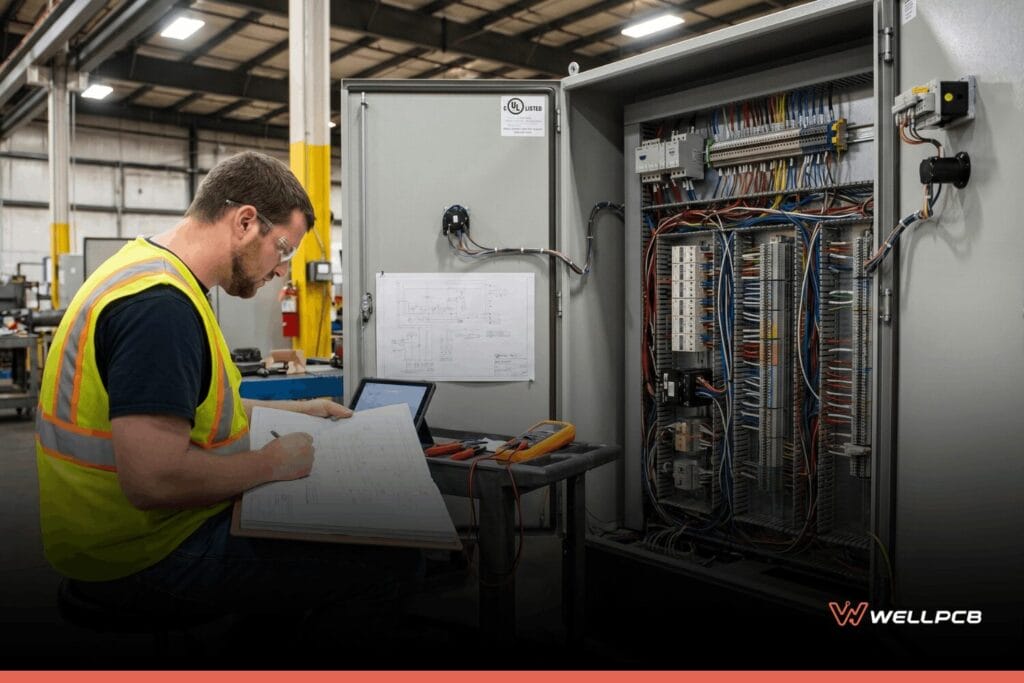
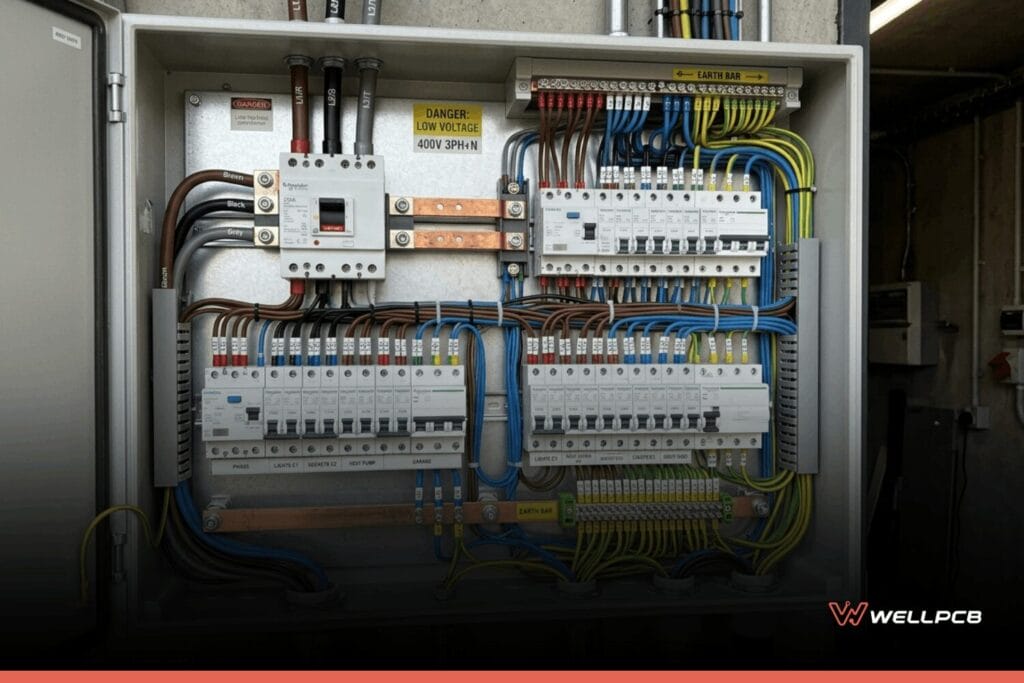
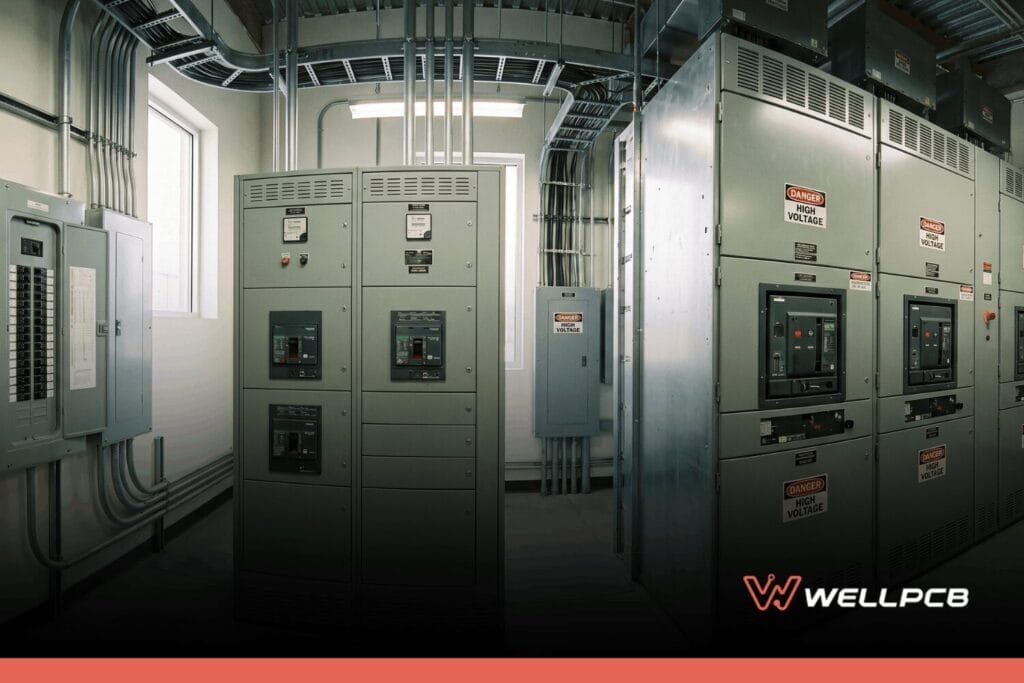
An effective low voltage (LV) distribution panel is defined by more than its nameplate. Its design must account for transformer capacity, available fault current, and the true demand of downstream loads. A poorly matched panel can lead to nuisance tripping, failed inspections, and costly downtime. Site conditions—from a clean office to a dusty manufacturing plant—are as critical as the current rating, dictating enclosure and layout choices that ensure long-term reliability.
Future expansion matters too. IEC 61439 is the governing standard for low-voltage switchgear and controlgear assemblies, and it sets verified limits on how a panel can be modified or extended without voiding its compliance basis. A panel specified with spare ways and busbar capacity from the outset costs little more at build time, but avoids the more expensive problem of a board that can’t accommodate new circuits without a full replacement.
Contents
- 1 What is a Low-Voltage Distribution Panel?
- 2 Where are LV Distribution Boards Used?
- 3 Components Inside a Low-Voltage Distribution Panel
- 4 Types of Low-Voltage Distribution Panels and Boards
- 5 Ratings, Standards, and Safety Considerations
- 6 Choosing and Specifying an LV Distribution Panel
- 7 Working With the Right Manufacturer Supplier
- 8 Low Voltage Distribution Panel FAQs
What is a Low-Voltage Distribution Panel?

A low-voltage distribution panel is the assembly that receives low-voltage power, then routes it through protective devices to downstream loads. Most LV distribution paneling operates at 230/400 V or 277/480 V, with many systems rated up to 600 V.
Inside the enclosure, the LV board handles power distribution and adds overload and short-circuit protection, with control or monitoring where needed. Depending on the region, engineers may refer to the same unit as a low-voltage panel or an LV switchboard.
In other installations, LV panel or distribution board labels describe a similar assembly. A common example is a transformer that supplies power to lighting circuits and motor loads in a building.
Where are LV Distribution Boards Used?
LV distribution boards are used where electrical systems need safe control and dependable fault isolation. In each setting, the panel has to match the load profile and service conditions. A low-voltage distribution panel in a clean office does not face the same stress as one exposed to dust, water, or vibration.
- Manufacturing plants use a low-voltage panel to feed machinery, support motor control, and protect circuits in harsh industrial applications.
- Oil and gas sites use LV distribution with robust breaker settings because outages can disrupt critical power and raise safety risk.
- OEM machinery uses LV panel layouts to route power to internal drives, sensors, and control assemblies.
- Office towers and malls use distribution boards to supply heating, ventilation, air conditioning, lighting, elevator control, and escalator systems.
- Hospitals and schools use electrical distribution systems with generator tie-ins so life-safety services remain reliable during utility outages.
- A data center uses low-voltage switchgear, redundant feeds, and energy monitoring to support stable cooling and server uptime.
- Renewable energy plants use distribution assemblies at transformer or inverter outputs to connect generation to the wider distribution system.
Components Inside a Low-Voltage Distribution Panel
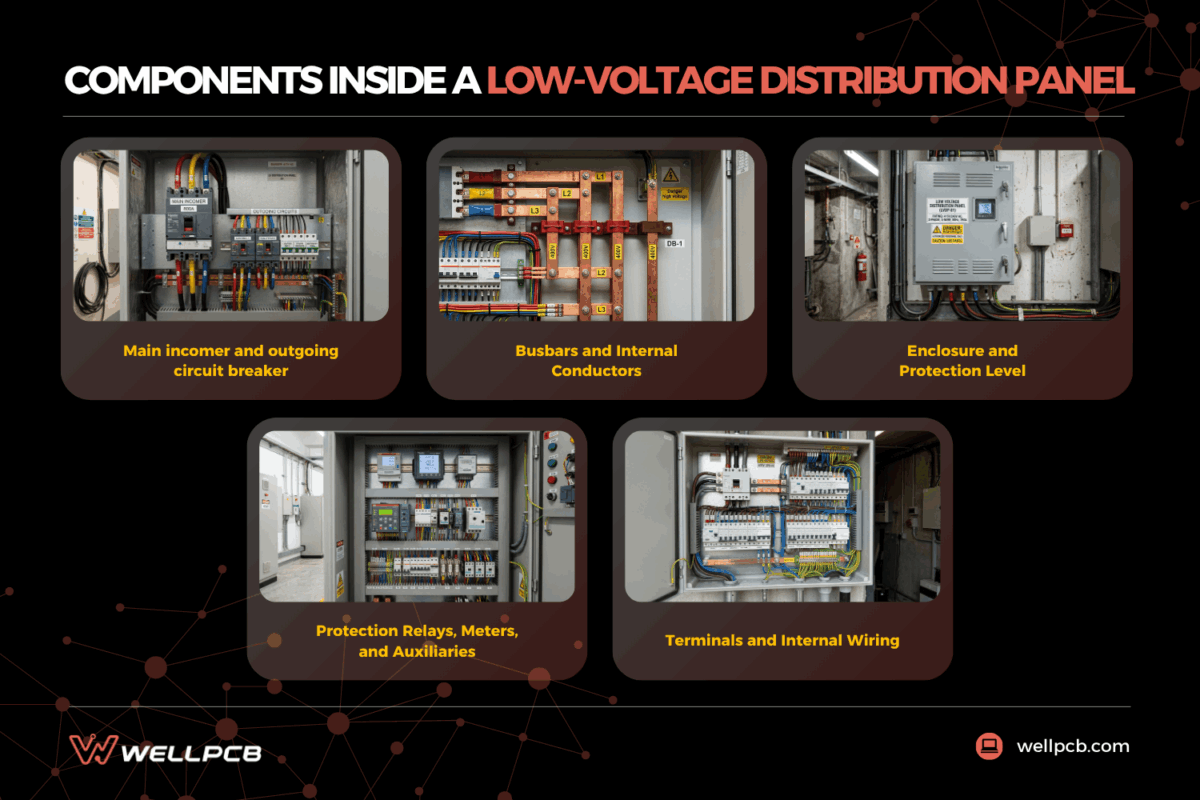
In a modern LV board, each component must work as part of a coordinated assembly that supports safe LV distribution under both normal and fault conditions. Switchgear, conductors, and the enclosure each shape access, protection, and service life.
Main incomer and outgoing circuit breaker
At the line side, the main incoming device serves as the master disconnect and isolates the full distribution section during maintenance or fault work. An air circuit breaker is common on larger boards.
A molded case circuit breaker or fused switch may be used when the application, fault level, and frame size support that choice. Downstream protection uses each circuit breaker to protect feeders and final circuits.
Smaller outgoing ways may use miniature circuit breakers with tighter trip settings for final circuit protection. Correct coordination limits overload damage and clears a short circuit before it spreads.
Busbars and internal conductors
Behind the protective devices, copper or aluminum busbars form the backbone for power distribution and carry load current to each outgoing section with low impedance. Many layouts use a horizontal main bus. Vertical risers then extend voltage distribution to feeder devices and branch sections inside the board.
Poor spacing or loose joints can raise heat and reduce power quality. Busbar sizing must reflect the current rating, joint design, fault stress, and acceptable temperature rise during continuous duty.
Enclosure and protection level
The cabinet provides the physical enclosure that supports segregation, mechanical protection, and shielding from accidental contact with energized parts during operation or service.
Indoor rooms may use lighter protection ratings. Outdoor areas often require distribution cabinets with stronger sealing against dust and water ingress and greater resistance to weather exposure.
Earthing bars, door interlocks, and internal barriers improve electrical safety for maintenance personnel. For a panel builder, enclosure choice affects compliance, access, and long-term reliability.
Protection relays, meters, and auxiliaries
Where fixed breaker settings are insufficient, protection relays provide selective fault response and sharper control over trip behavior in complex electrical systems. Earth-fault modules are often added first.
Surge protective devices and arc flash mitigation features may be included when service conditions, risk exposure, and operating continuity demand stronger protection. A multifunction meter can show current, voltage, and power factor during live operation. Status indication helps technicians diagnose abnormal power usage without intrusive testing.
Terminals and internal wiring
On the outgoing side, terminal blocks provide serviceable landing points for each circuit conductor, making it straightforward to modify or replace connections during testing and maintenance work.
Clearly labeled wiring shortens the time technicians spend tracing circuits during faults or modifications. This is a practical detail that becomes more valuable as the board grows in size and feeder count.
Separated routes for power, control, and communication wiring reduce errors and protect adjacent terminations from accidental disturbance during service. Modern low-voltage power panels often reserve space for control signals and energy monitoring links.
Types of Low-Voltage Distribution Panels and Boards
A poor match between board type and application creates problems that compound over time: an undersized board may nuisance-trip under peak load, fail inspection due to inadequate fault rating, or force a full replacement when the first expansion circuit is added.
Low-voltage distribution panels fall into several structural categories, each serving a distinct role in the power path from transformer to final circuit. Selection depends on load size and fault level, then on how each facility segments power.
Function in the distribution hierarchy
Each board type serves a distinct position in the power path. Hierarchy affects coordination, selectivity, and how faults are contained upstream or downstream.
- A main distribution board receives supply from a transformer or main service.
- A sub-main distribution board divides power across zones and major systems.
- Final panel boards feed end-use circuits after upstream distribution boards split the supply by area.
Construction and mounting
The mounting style changes based on the current level, feeder count, and installation space. The physical format affects maintenance access and the room for later modification.
- Wall-mounted LV boards serve smaller loads in corridors or utility rooms.
- Floor-standing switchboards or LV panel lineups use modular cubicles for higher current and more feeders.
- Larger assemblies leave clearer space for future changes as demand rises.
Internal separation (IEC 61439 Form 1-4)
Under IEC 61439, Form 1 provides no internal separation.
Form 4 fully isolates busbars and functional units, improving fault containment during service work. Many industrial low-voltage panels and motor control centers use Form 3 or 4 because stronger segregation supports safer maintenance.
Ratings, Standards, and Safety Considerations
Ratings define how safely an LV board performs under load, and selecting the wrong values is one of the more common reasons panels fail inspection or require early replacement.
Understanding key rating parameters, compliance standards, and protection coordination is critical. These factors determine if an LV board will perform safely under load or fail an inspection.
Voltage and current ratings
Many low-voltage panels are rated for 230/400 V or 277/480 V service. Actual ratings depend on the installation, regional system voltage, and panel design.
Busbars in power distribution assemblies may range from a few hundred amps up to 5,000 A. Short-circuit strength, including breaker Icu and Ics values, has to exceed the calculated fault level at the site.
A tested assembly gives the rating real meaning under heat and fault conditions.
Standards and compliance
IEC 61439-1/2 is the main standard for switchgear and controlgear assemblies. It replaced IEC 60439 and shifted compliance toward verified design rules for each tested panel.
A panel builder has to preserve the verified conditions when selecting parts, then document the finished construction details. Without design verification, compliance claims can fail during inspection or in later fault review.
Coordination and protection
Protection coordination links the upstream switchgear with the downstream LV distribution section properly.
Selective settings keep a feeder fault local, so a single trip doesn’t drop the entire panel. Added safeguards may include earth-fault protection and arc-flash mitigation, followed by clear labels and adequate working space for access.
Choosing and Specifying an LV Distribution Panel
A low-voltage distribution panel must match the actual site duty. Assessing loading, defining the right specification points, and accounting for the installation and maintenance factors determine whether the panel remains serviceable over its full working life.
Load and system assessment
Start with total demand, diversity, and realistic spare capacity. These figures help you choose the right LV distribution board for each level of the system.
Indoor rooms, hot spaces, and corrosive areas may each require different enclosure materials and IP or IK protection levels to ensure a dependable service life.
Specification points
Define the service voltage, busbar rating, and calculated fault level early. The form of separation should be fixed because it affects safety, access, and footprint. You should state whether the build needs modular sections for future feeders, then specify meter functions, communication links, and ties to UPS systems or building controls.
Installation and maintenance factors
Access requirements shape installation speed and long-term service work. Front access may suit one room, while front and rear access may better fit a larger distribution box or lineup.
Cable entry direction, bend space, clear schedules, and durable labels all matter because good documentation helps inspectors approve the LV board and helps technicians work faster later.
Working With the Right Manufacturer Supplier
Beyond initial build quality, supplier consistency is crucial. For repeat orders or multi-site deployments, variations between panels can create significant serviceability and maintenance challenges. A reliable manufacturing partner ensures every panel adheres to the same verified design and quality standards.
WellPCB’s assembly facilities operate under ISO 9001 quality management and IPC 610 Class 3 build standards, with each panel inspected and tested against the approved design before dispatch. Controlled fabrication, verified assembly practices, and documented testing help each panel match the intended distribution design, fault-protection requirements, and service conditions.
Request a quote to move your next low-voltage distribution panel project forward with traceable, build-ready assemblies.
Low Voltage Distribution Panel FAQs
What is a low voltage distribution panel?
A low-voltage distribution panel is an electrical cabinet that receives low-voltage power from a main supply or transformer. It then routes power to downstream circuits through a controlled distribution path. Inside the panel, protective devices support switching, fault isolation, and safe power distribution across the system.
What is the typical voltage range of an LV distribution panel?
Many LV distribution panels are designed for systems up to 1,000 V AC. Common service voltages include 230/400 V and 277/480 V three-phase systems. Within that range, the LV panel assembly supports feeder protection, switching duties, and coordinated control for downstream loads.
What are the main components inside an LV board?
A typical LV board includes an incoming circuit breaker or switch, outgoing protective devices, and busbars that carry current through the board.
The assembly includes an enclosure, an earthing bar, and cable termination points for incoming and outgoing conductors. Many low-voltage distribution panel designs include metering, relays, and surge protection to improve visibility and safety.
How do I choose the right low-voltage distribution panel for my project?
Start with the total load, diversity, and planned expansion margin. Then define the required voltage, fault level, and access needs for the installation. The right low-voltage panel should match the service environment, support future circuits, and provide the protection level your application requires.
Back to Top: Low Voltage Distribution Panel: Guide for LV Distribution